Hiring Mistakes That Quietly Stall Strategic Business Growth
One wrong hire can drain months of cash flow and pull you back into the daily work you hired someone to take over. The damage rarely shows up right away. It shows up later, when revenue flattens, decisions pile up on your desk, and your best people start disengaging.
In our experience, most hiring mistakes come from missing systems, not bad candidates. Below are the three costliest mistakes we see business owners, SaaS leaders, and contractors make, along with how to fix each one.
Hiring Mistakes That Stall Growth
Hiring for Output, Not Outcomes
Many teams get rewarded for volume: tasks closed, code shipped, reports produced. Volume feels like progress, but it often has little to do with business value. AI makes the problem worse. Anyone can now produce a 2,000-word marketing strategy or a complex financial model in about thirty seconds, so if you judge people by how much they produce, all that output turns into noise.
Goodhart's Law explains why: "When a measure becomes a target, it ceases to be a good measure." The research shows the same gap. In McKinsey's latest AI research, 80% of respondents say AI improved individual productivity, but only 44% say it is scaling across the enterprise. People feel busier and more productive, but the business doesn't grow faster.
Here is how this looks by industry:
Business Owners hire doers who produce deliverables but never build repeatable systems.
SaaS teams add headcount before anyone has defined who owns which result.
Contractors promote their best tradesperson into a crew lead role and give them no leadership support.
Hiring Without Accountability Systems
A new hire can't fix a broken management system. If the role has no scorecard, no clear ownership, and no regular check-ins, every decision still comes back to you. The team learns to wait for direction, rework increases, and you burn out.
Management quality has a measurable effect on results. Gallup found that managers account for at least 70% of the variance in employee engagement across business units. That makes accountability a growth issue, not just an HR task.
You can check where you stand with one question we ask every client: Does my team have Connection, Autonomy, Measurement, and Purpose? If one of those is missing, adding a new person will make the gap bigger, not close it.
Rushing a Hire to Solve a Performance Problem
When a current employee is underperforming, it's tempting to fill the gap fast. But a rushed hire doesn't solve the problem. It postpones it. When you hire in a hurry, you're focused on the problem in front of you today, not on the person who will move the business forward.
This costs you in two ways. First, your team notices. A panicked hire tells them leadership is reacting instead of planning, and that hurts the culture. Second, the hire itself is expensive. SHRM puts the average cost per hire at nearly $4,700, and some employers estimate the total cost reaches three to four times the role's salary. If the rushed hire is a manager, the cost can be much higher, because a poor manager can drive away your best people.
Choosing the Right Hiring Support
The CAMP Hiring Framework
We built our hiring approach on CAMP because it turns leadership theory into clear day-to-day operations. In practice, it follows three steps:
Define each role by outcomes. Write down the business results the role owns before you write the job posting.
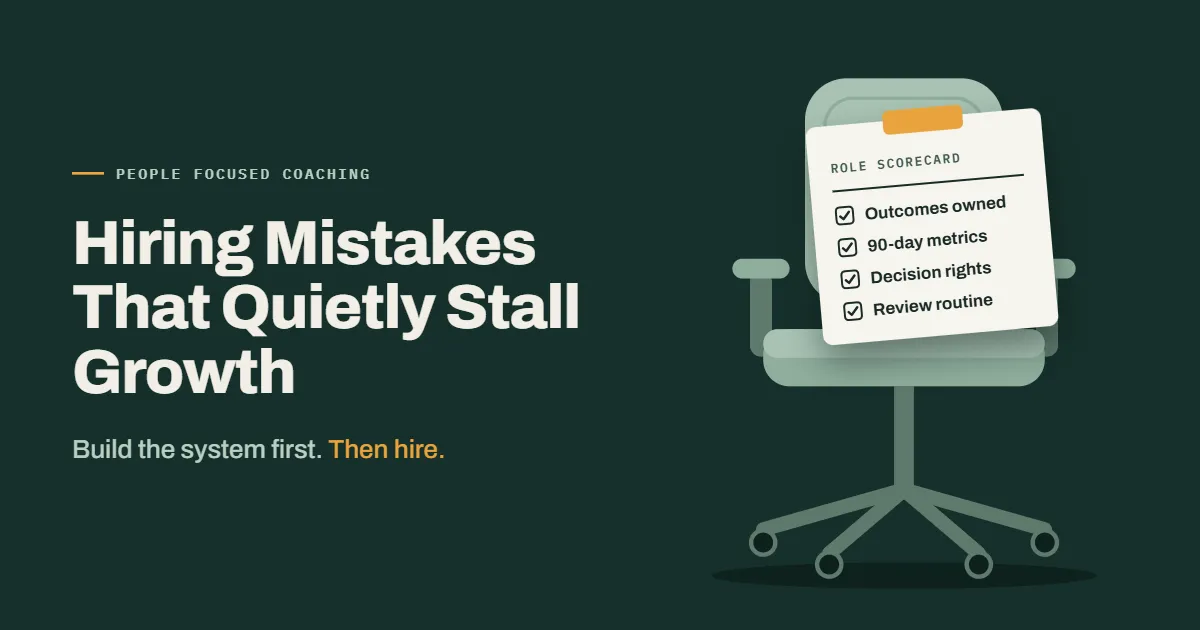
Set accountability metrics before hiring. If you can't measure success in the first 90 days, the role isn't ready to fill.
Build onboarding that reduces owner dependence. Give new hires decision rights, a scorecard, and a review routine so they don't route everything through you.
The framework comes from 20 years of leading teams at Fortune 500 companies and agile scale-ups. That work included consistently speeding up delivery by 50 to 70% while improving quality, managing a $90 million profit center and a team of 120, and closing $100 million in investment. We use the same operating discipline with owners who want to scale without becoming the bottleneck.
How the Options Compare
Factor | DIY Hiring | Generic Business Coaching | Industry Programs | People Focused Coaching |
|---|---|---|---|---|
Systems built | Rarely | High-level only | Tactical templates | Role scorecards, metrics, onboarding |
Team accountability | Owner-dependent | Inconsistent | Varies | Built through regular CAMP review routines |
Measurable results | Hard to track | Loosely defined | Program-level | Tied to role outcomes and business metrics |
Fit for business owners, SaaS, contractors | Low | Moderate | Narrow | Tailored to all three |
DIY hiring looks cheap until you add up the cost of a bad hire. Our work goes further than advice. We put a working system in place so that each new hire grows the business instead of creating more work for you.
Build the System First, Then Hire
Hire against outcomes and accountability systems, not job titles or output volume. That's how you protect cash flow, win back your time, and build a business that runs without you in every decision.
If hiring has felt like a gamble lately, book a strategy call with People Focused Coaching. We'll audit your hiring and team performance gaps and show you where the bottlenecks are.
Frequently Asked Questions
What coaching helps Ontario agency owners scale without burnout?
Look for coaching that focuses on systems, delegation, and team accountability so you stop being the bottleneck. We build this through role scorecards and the CAMP framework, which together reduce rework and move client delivery decisions off your desk.
How can Ontario SaaS founders improve team performance?
Measure outcomes instead of output, make it clear who owns what, and protect core skills as AI adoption grows. Structured coaching helps founders put these practices in place before they add headcount, which is when they cost the least to fix.
Which coaching improves accountability for Ontario contractors?
Choose a program that sets clear performance metrics, prepares crew leads to lead, and builds regular review routines. Those three pieces are what keep the owner from having to be on every job site.