Avoid the Doorman Fallacy. Practical AI Decision-Making for Scalable Operations
Avoid the Doorman Fallacy with Practical AI Decision-Making
AI can remove friction fast. It can draft, summarize, sort, and accelerate work that used to consume hours. The mistake is assuming that because a task looks repetitive, the role behind it has no deeper value. That is the doorman fallacy, automating the visible activity while stripping out judgment, trust, escalation, and accountability.
That distinction matters more now because adoption is moving from experimentation to operations. In Canada, 12.2% of firms used AI in 2025, up from 6.1% the year before, and another 14.5% planned to adopt it within 12 months. The opportunity is real, but so is the risk of using AI in ways that create more owner dependence, more rework, and weaker quality control, according to national adoption data.
For Ontario agency owners, contractors, and software founders, the goal is not more output. It is better decisions, stronger systems, cleaner execution, a better customer experience, and more time freedom.
Where AI Helps, and Where It Hurts
The doorman fallacy shows up when leaders reduce a role to its task list. A client coordinator is not just sending updates. A project manager is not just moving tickets. A site lead is not just relaying instructions. In each case, the real value often sits in the human layer, reading tone, catching risk, resolving ambiguity, and owning the outcome when something slips.
That is why we coach teams to treat AI as a collaborator, not a substitute for thinking. The first question is not, "Can this be automated?" It is, "What business result are we trying to improve?" Faster sales follow-up, fewer missed handoffs, cleaner estimates, better retention, and fewer owner escalations are all valid targets. Generic content production is not.
A simple filter for practical AI decisions
A useful AI decision process should be easy enough to apply in a weekly leadership meeting. We use a four-part filter.
Start with the outcome
Name the result in operational terms. That could mean reducing quote turnaround time, improving lead response consistency, or cutting rework between sales and delivery. If you cannot define the outcome, you should not automate the process yet.
Protect the human contribution
Some work needs judgment more than speed. In our own guidance on bionic teams, we train leaders to preserve context-setting, healthy skepticism, and what we call the human polish. That means your team still fact-checks, questions assumptions, and applies empathy before anything reaches a client.
Require human thinking first
We also set a hard boundary at the front end. Team members should spend the first 15 to 20 minutes of a new project brainstorming, whiteboarding, or outlining before they consult AI. That prevents skill atrophy and keeps ownership with the person, not the tool.
Measure noise eliminated
Volume is a weak metric in an AI environment. If a tool helps your team generate more text but also creates more confusion, it failed. Measure fewer errors, fewer back-and-forths, fewer missed commitments, and faster decisions. Internally, we describe this as judging AI by how much noise it eliminates, not how much text it generates.
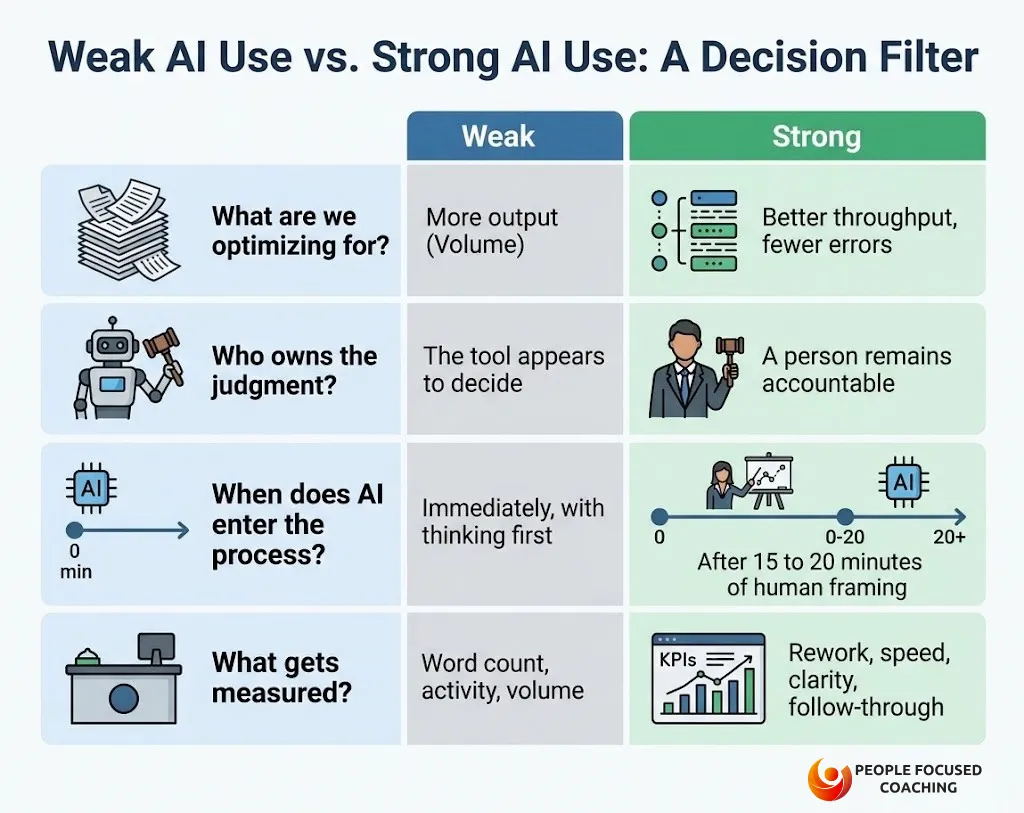
Decision question | Weak AI use | Strong AI use |
|---|---|---|
What are we optimizing for? | More output | Better throughput and fewer errors |
Who owns the judgment? | The tool appears to decide | A person remains accountable |
When does AI enter the process? | Immediately, with no thinking first | After 15 to 20 minutes of human framing |
What gets measured? | Word count, activity, volume | Rework, speed, clarity, follow-through |
Growth systems need accountability, not just automation
For agencies and contractors, AI works best as a support layer inside a clear operating system. It can help standardize follow-up, document handoffs, organize notes, and surface gaps. It cannot replace leadership discipline.
That is where many scaling businesses get stuck. Sales lives in one workflow, delivery in another, and the owner sits in the middle cleaning up misalignment. We fix that by building process, delegation habits, and accountability rhythms that reduce founder dependence. The point is not to make the owner faster at answering everything. The point is to make the business less dependent on the owner answering everything.
Our coaching is grounded in operating realities, not theory. Brian Olynyk brings 20 years of engineering experience leading teams at Fortune 500 companies and agile scale-ups. Before coaching full time, he accelerated delivery by 50-70% while improving quality, managed a $9 million profit center and a team of 120, and helped close $100 million in investment by bridging product and profit. That background shapes how we build systems for execution, not just ideas.
The same principle applies on job sites and in field operations. Contractors do not need AI to create prettier paperwork. They need clearer commitments between office and field, stronger team ownership, fewer dropped details, and more predictable cash flow. Autonomy helps, but only when it has structure. In our C.A.M.P. framework, we state it plainly: autonomy without accountability is chaos.
Software teams need bionic standards
Software founders face a different version of the same problem. Individual experimentation is already happening whether leadership has a policy or not. Statistics Canada found that 22% of workers used generative AI at work over the previous 12 months, which means team-level usage is often ahead of company-level governance, as shown in this workplace AI profile.
That is why startups need bionic team standards. Let AI accelerate drafting, summarizing, testing support, and triage. Keep humans responsible for architecture decisions, fact-checking, critical thinking, and final quality. If your team is rewarded for sheer output, quality will drift. If it is coached on discernment, accountability, and measurement, AI becomes a lever instead of a liability.
The kind of coaching that actually changes execution
Business owners usually do not need more insight. They need follow-through. The right coaching should connect leadership behavior to measurable operating results: cleaner delegation, clearer priorities, better handoffs, stronger team ownership, and less owner bottlenecking.
That is why our work combines leadership development with practical systems. We use the C.A.M.P. framework, Connection, Autonomy, Measurement, and Purpose, because AI adoption only sticks when the team understands the why, has room to act, knows how success is measured, and trusts the people around them. Broader organizational research points the same way. Effective AI adoption depends on governance, accountability, and human understanding, not just tools, according to organizational research.
If you are trying to scale without burning out, this is the standard to hold. Coaching should help you reduce owner dependence, improve execution quality, and turn AI into a business advantage that shows up in time, cash flow, and capacity.
Better AI decisions start with a better operating system
AI is most useful when it supports a business that already values judgment, trust, and accountability. It should help your team remove friction, not remove thinking. Used well, it sharpens execution. Used poorly, it amplifies noise.
If your business is growing but still relies too heavily on the owner, this is the right time to look at the system underneath the workload. We help Ontario businesses identify bottlenecks, accountability gaps, and the next practical AI decisions that improve performance without sacrificing quality. Book a conversation with People Focused Coaching, and we will map where AI belongs, where it does not, and what your team needs next.
Common questions owners ask
How much does business coaching for agency owners cost in Ontario?
Cost matters, but outcome matters more. Evaluate coaching by the capacity it creates, the cash flow consistency it supports, the accountability it builds, and the degree to which it reduces owner dependence. A cheaper program that leaves the founder in every decision is expensive in practice.
Can coaching help with contractor burnout and team accountability?
Yes. The business issue is usually not motivation alone. It is unclear expectations, weak delegation, inconsistent follow-through, and too many decisions flowing back to the owner. Coaching addresses those operating and leadership issues directly. Therapy and coaching can complement each other, but they solve different problems.
What coaching helps Ontario software startups scale teams without losing quality?
Look for coaching that combines leadership development, delegation systems, AI collaboration standards, quality controls, and clear ownership metrics. Startups do not lose quality because people work too slowly. They lose quality when speed outpaces decision discipline.