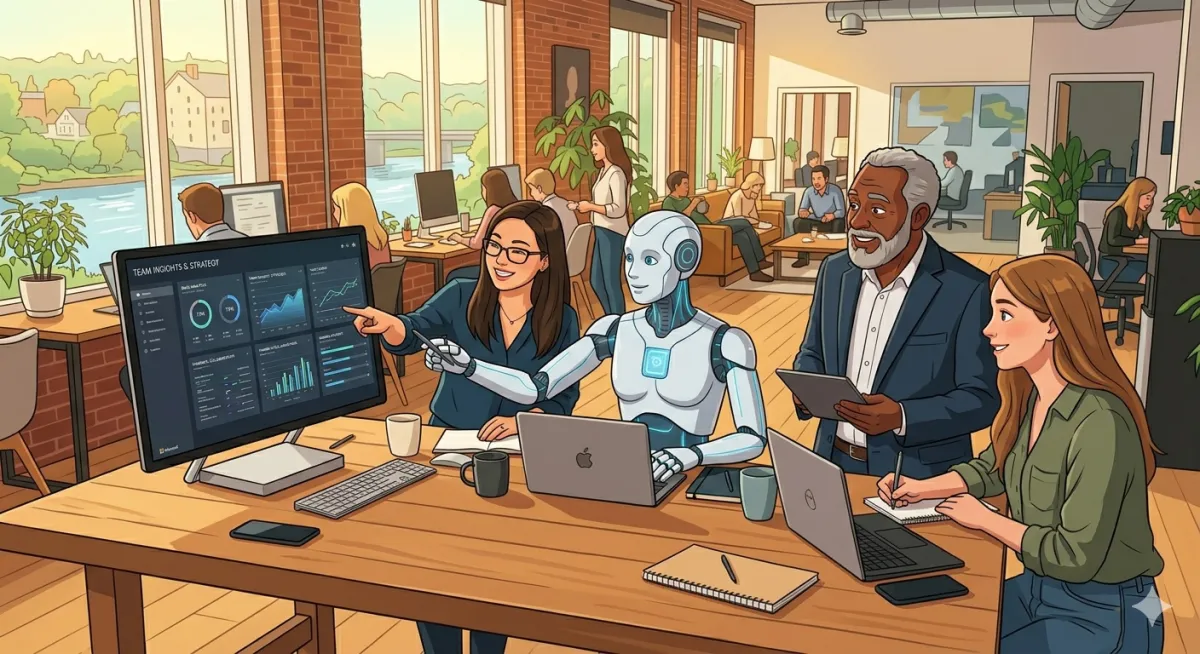
Leading Bionic Teams: AI Collaboration Tips
The Bionic Team: How to Lead Humans Who Work with AI (Without Losing the Human Element)
If you run a business, your social media feeds, emails, and news alerts have likely been flooded with the exact same narrative for the past few years: AI is coming for your team’s jobs. We’ve been told that copywriters, developers, analysts, and administrative assistants are on the verge of replacement. Managing a real team in a fast-paced environment, you’ve realized the truth is much more nuanced. AI isn't replacing your people. Instead, it’s an opportunity to change how they work.
We are entering the era of the Bionic Worker, the professional who pairs human intuition, empathy, and taste with the sheer processing power of artificial intelligence.
As a leader, this shifts your job entirely. Your new challenge is managing the relationship between your team and their digital assistants.
Here is how to lead a bionic team without losing the human core that makes your business unique.
1. Shift Your Metrics from "Output" to "Discernment"
Managing and measuring “things” is easy. Measuring volume and speed feels satisfying but it can be misleading. How many blog posts did the marketing assistant write this week? How many data sheets did the operations manager compile? How much code did the development team write?
AI has turned the volume of work that can be produced from an asset to a liability. Today, anyone can generate a 2,000-word marketing strategy, a complex financial mode, or a new product featurel in about thirty seconds. If your business relies solely on the volume of output, you’re competing in a race to the bottom.
As a leader, you must train your team, and yourself, to value discernment, curation, and taste over speed. Said another way, are we making the right things, with quality, that we won’t regret later?
The bionic worker’s value doesn't lie in their ability to generate text or data; it lies in their ability to look at an AI-generated PR and say: "This is technically correct, but it’s completely ignoring our architecture. Let’s rewrite this section to make it consistent with what’s already there." Reward your team for their critical thinking and editing eyes, not just for pushing to production faster..
2. Coach the 3 Core "Bionic" Skills
To guide your team away from using technology as a crutch and toward using it as a collaborator, you need to coach them on three specific human-centric skills:
Context-Setting: AI is only as good as the guardrails we give it. Teach your team how to feed deep business context, historical client nuances, and specific constraints into their tools. The magic isn't in the answer; it’s in the prompt.
Healthy Skepticism: AI defaults to averages and, occasionally, completely hallucinates facts. Bionic workers must act as the ultimate quality control. They need to fact-check, question assumptions, and ensure accuracy before anything reaches a client’s hands.
The "Human Polish": Empathy cannot be automated. Whether it’s navigating a sensitive client relationship, resolving a conflict, or understanding the emotional subtext of a deal, your team must inject real-world emotional intelligence (EQ) into the raw data technology provides.
The Trap of "Tokenmaxxing": More Words is Not More Value
As you coach your team to use AI, you need to watch out for a dangerous new workplace phenomenon: Tokenmaxxing. In the world of AI, "tokens" are the basic units of text the machine processes and generates. "Tokenmaxxing" happens when an employee prompts an AI to take a simple, two-sentence update and inflate it into a massive, multi-page corporate manifesto, simply because the technology makes it effortless to do so.
It’s the digital equivalent of adding fluff to a college essay to hit a word count.
Remember Goodhart’s Law:
“When a measure becomes a target, it ceases to be a good measure.”
- Charles Goodhart
Tokenmaxxing is a massive productivity killer. It creates a toxic loop: one employee uses AI to generate an unnecessarily long email or report, and the recipient then has to use another AI tool just to summarize it back down to the original two sentences. Trust is eroded and employees start to things others are completely incompetent.
The Leadership Fix: Measure what matters. Remind your team that AI should be used to achieve clarity and speed, not volume. Challenge them to evaluate their AI collaborations by how much noise they eliminate, not how much text they generate. Trust your team to make the right choices.
3. Protect Against "Skill Atrophy"
Think about what happened to our collective sense of direction when GPS became mainstream. Suddenly, our ability to read maps and navigate spaces faded. We stopped using the skill and we stopped teaching the skill. The same threat applies to your team's professional skills.
If a junior designer uses AI to generate logos without ever sketching a concept by hand, or a junior writer uses it to draft emails without learning how to structure an argument, their foundational thinking muscles will atrophy.
The Leadership Fix: Establish healthy operational boundaries. Encourage "blank page" thinking. Challenge your team to spend the first 15 to 20 minutes of a new project brainstorming, whiteboarding, or outlining before they consult an AI tool. This ensures that the human spark always drives the machine, rather than the other way around.
The Ultimate Form of Delegation
In leadership, we talk a lot about delegating tasks to our team to free up our own strategic bandwidth. The bionic era takes this a step further. By teaching your team how to effectively "delegate" their routine, time-consuming grunt work to AI, you elevate your entire organization.
You move your people away from repetitive tasks and push them directly into higher-value work. The result? A happier, more fulfilled team that behaves like strategic partners rather than line workers.
The future doesn’t belong to businesses that try to turn their employees into efficient robots. It belongs to the leaders who use technology to unlock what makes their people uniquely human.
Over to You
What is one repetitive, time-consuming task your team handles weekly that could be turned into a collaborative project with an AI tool? How can you help them make that shift this week?