Are You Happy at Work? Your Team’s Performance Might Depend on It
Despite countless leadership books, courses, and management strategies, many teams still struggle with disengagement and underperformance. One often-overlooked factor might be the simplest: happiness at work.
Surveys on job satisfaction vary wildly. Some report that 44% of employees are unhappy, while others suggest up to 80% are mostly content. Wherever the truth lies, one fact is clear: happy employees drive better business outcomes.
According to research, happy employees are:
180% more energized
108% more engaged
50% more motivated
50% more productive
A happy workplace doesn’t just benefit the company, it makes work more enjoyable for everyone. And when work is enjoyable, job satisfaction follows. People want to work at fun, successful companies.
But how do you build that kind of workplace?
The Missing Link: A Practical, People-First Framework
You’ve probably taken leadership training or read management books. Most offer helpful insights that are a piece of the puzzle, but rarely do they pull everything together in a cohesive, actionable way.
That’s why I developed the C.A.M.P. framework: a management model that puts individual happiness at the center. After over a decade in leadership, including internationally, I’ve distilled the most effective strategies into a simple yet powerful approach. These principles can be applied at all levels of leadership.
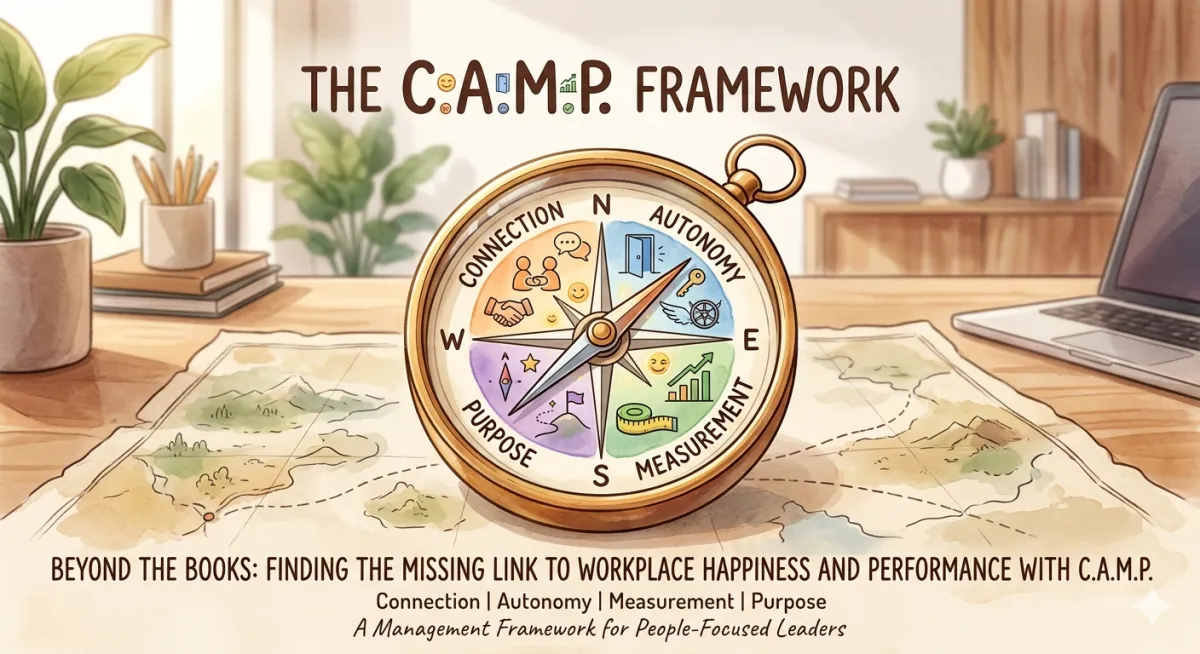
C.A.M.P. stands for Connection, Autonomy, Measurement, and Purpose. It’s designed to identify what’s holding individuals and teams back to help them reach their full potential.
Introducing the C.A.M.P. Framework
Happy individuals make for high-performing teams. C.A.M.P. focuses on four key pillars that foster both happiness and productivity:
1. Connection
Do team members enjoy working together?
Do they feel aligned with company and leaders values?
Why it matters: Without strong interpersonal and working culture alignment, teams tend to feel fragmented. You might hear gossip or complaints that aren’t addressed directly, always going through the manager instead. Building connection, especially in remote settings, requires intentional effort. Team-building activities or informal interactions outside project work are critical.
2. Autonomy
Does the team have what it needs to take ownership of its work and experiments?
Are individuals learning from mistakes and making decisions confidently?
Why it matters: A team without autonomy will hesitate to act, constantly seeking approval. Autonomy needs to include accountability, otherwise the team may build cool things that have no business value. Both extremes lead to frustration. True empowerment balances freedom with responsibility.
3. Measurement
Can progress be demonstrated in a way that matters?
Are the team’s efforts moving the needle?
Why it matters: Without clear metrics, even strong teams can seem slow or aimless. Measurement tells you when success is achieved, whether through project milestones, learning goals, or reduced inefficiencies. We’ll explore effective vs. ineffective metrics.
4. Purpose
Does the team understand why they’re doing the work?
Does everyone know what’s in it for them?
Why it matters: Purpose is the most fragile pillar. Over time, even well-defined missions fade. Without regular reinforcement, teams drift, delivering “stuff” that doesn’t really matter. A clear, inspiring purpose ensures alignment and long-term motivation.
Spotting the Gaps
Each pillar plays a critical role. If one is missing, the team may still function, but not thrive. Here’s what the absence of each pillar might look like:
Lack of Connection: Disengaged coworkers, surface-level relationships, indirect complaints.
Lack of Autonomy: Reluctance to take initiative, fear of failure, misaligned output.
Lack of Measurement: Vague timelines, unrealistic expectations, confusion about progress.
Lack of Purpose: Busywork with no impact, fragmented priorities, fading enthusiasm.
When all four are present, something remarkable happens: your team delivers not just results, but energy. They laugh together more, solve problems faster, and attract others who want to work the same way.
How to use the framework?
When you’re starting or taking over a project, use it as a checklist to look for strengths and weaknesses in the team. For example:
Does the team know each other beyond just working together? Maybe you need a team building event.
Does the team have the support it needs to experiment? Do people feel like they can make and learn from mistakes?
Is it clear what you’re watching for progress? The team must be watching the same metrics.
Does everyone understand why the project is important for the business?
Start with the team and then use more personalized questions for individual team members. You’ll be able to find surprising opportunities and challenges.
What’s Next?
This article is just the beginning. In this series, I’ll break down each pillar of C.A.M.P. in greater detail, sharing specific tools, stories, and strategies for identifying gaps and improving team performance.
In the meantime, ask yourself:
Does my team have Connection, Autonomy, Measurement, and Purpose?
If not, that’s where your leadership journey should begin.